
Welcome to the Week in Review.
SCOTUS Denies Pharma Petitions
The Supreme Court denied petitions from six major drugmakers — AstraZeneca, Bristol Myers Squibb, Janssen, Novartis, Novo Nordisk, and Boehringer Ingelheim — leaving in place lower court rulings that rejected their challenges to the Medicare Drug Price Negotiation Program. After 16 losses for the industry in court, these pharmaceutical companies asked the Supreme Court to step in, and it declined. It’s the end of the line for these six drugmakers, and Medicare can continue delivering lower drug prices for patients without interruption, exactly what patients fought for. P4AD has been in this fight from the beginning, advocating for the program’s protection through amicus briefs, and this ruling vindicates that work. Four cases remain in the lower courts, from AbbVie, Merck, Teva, and PhRMA, but they rest on many of the same arguments courts have now repeatedly rejected. Pharma is running out of legal options. We’ll keep watching and keep pushing for the full implementation and expansion of Medicare negotiation. — [POLITICO, Epoch Times, AP, Endpoints News, STAT News, The Hill, CNN, Axios]
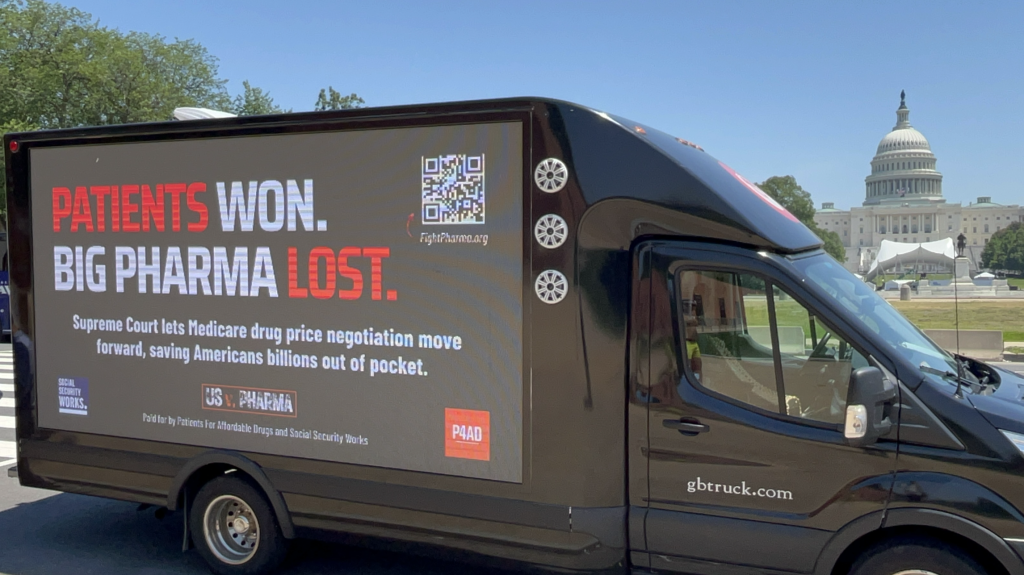
P4AD and Social Security Works’ joint mobile billboard traveled around D.C. on Monday, celebrating the news: Patients won, and Big Pharma lost.
TrumpRx Expansion: What It Is and Isn’t
President Trump announced this week that over 600 generic drugs are being added to TrumpRx, the administration’s direct-to-consumer discount website. The rollout is being billed by the administration as a major new affordability initiative, but in practice the platform aggregates and links to existing cash-discount programs available to patients through GoodRx, Amazon Pharmacy, and Mark Cuban’s Cost Plus Drugs. From what we’ve seen thus far, many of the coupon prices — including many from the original set of discounts — can only be fulfilled at large chain pharmacies like CVS and Walgreens that have the infrastructure to honor them. Patients who rely on independent pharmacies (including the nearly 20% of Americans reliant on rural pharmacies) or have insurance plan restrictions may not be able to access these prices at all. While TrumpRx may help some patients navigate existing options, it does nothing to address list prices, manufacturer pricing power, or the structural conditions that allow drug companies to price-gouge Americans for their essential medicines. — [New York Times, Rural Health Medicine, Washington Post, Reuters, USA Today]
Takeda Pharmaceutical Sued for Pay-For-Delay
A U.S. judge found Takeda Pharmaceutical liable for $885 million in damages this week after the company paid competitor Par Pharmaceutical to delay launching a generic version of the constipation drug Amitiza. The deal, struck in 2014, kept the generic off the market for seven years — leaving patients with no lower-cost alternative until 2021. Pay-for-delay deals let drug companies pay off competitors to stay out of the market, abusing the patent system to protect profits at patients’ expense. Takeda’s case is a win, but one verdict doesn’t fix a systemic problem. Congress needs to pass the bipartisan Preserve Access to Affordable Generics and Biosimilars Act to rein in these types of deals. The stakes are real: when one generic alternative enters the market prices can drop by 39%, and multiple can lead to a 95% reduction in price. — [Reuters, Fierce Pharma, Congress, FDA]
ICYMI: Virginia Governor Spanberger vetoed the state’s Prescription Drug Affordability Board (PDAB) this week — in a win for industry. Colorado became the first state to cap a prescription drug price through its PDAB last October, using it to lower the cost of the blockbuster drug Enbrel. — [VA Governor, Denver 7, Virginia Mercury, Virginia Scope]
Subscribe to the WEEK IN REVIEW here.