
Welcome to the Week in Review.
P4AD Patient Advocates on Capitol Hill
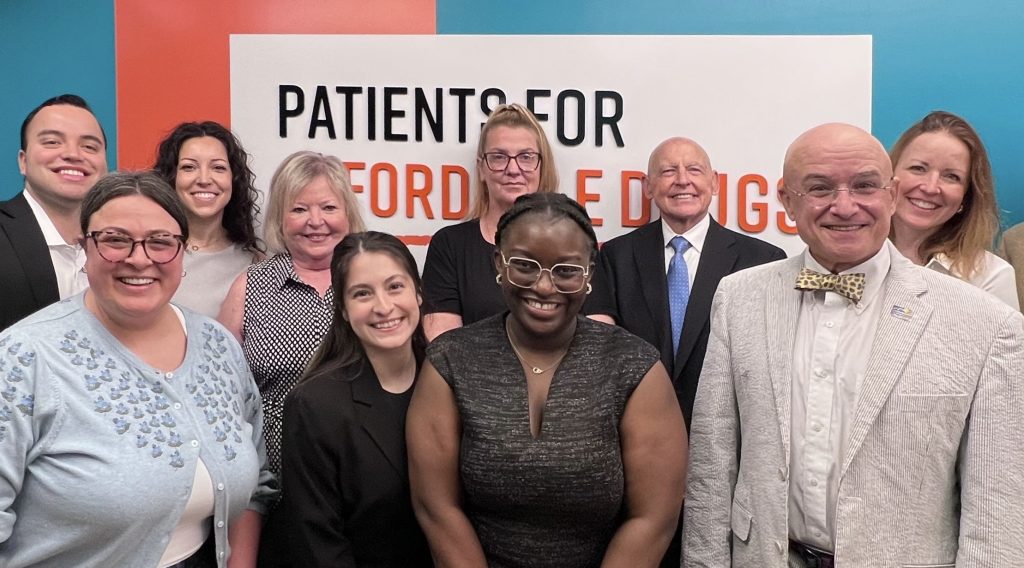
Over the last two weeks, P4AD patient advocates from across the country traveled to Washington, D.C., to share what high drug prices mean in real terms — skipped doses, delayed care, and impossible financial tradeoffs. They met directly with lawmakers on both sides of the aisle to urge action on reforms like the ETHIC Act, a bipartisan bill that would curb pharma patent abuses and help bring lower-cost generic and biosimilar alternatives to market faster. During meetings with lawmakers, patient advocates also described how the Medicare Negotiation Program is already improving their lives and how bills like EPIC would undermine hard-won progress. With nine in ten Americans calling on Congress to do more, their stories make clear what’s at stake — and why action can’t wait.
Regeneron Signs MFN Deal Alongside Gene Therapy Approval
Regeneron is the latest drugmaker to reach a most-favored-nation (MFN) pricing agreement with the Trump administration, part of a broader set of voluntary deals aimed at bringing U.S. drug prices in line with those in other high-income countries. The company was the last of the 17 corporations that received letters in July 2025. The White House announced the agreement alongside the expedited approval of Regeneron’s new gene therapy, Otarmeni, to treat a rare genetic form of hearing loss. The treatment was expedited through the FDA’s National Priority Voucher program. According to Regeneron, it will be available in the United States at no direct cost to patients. While we are thrilled for the families able to access this treatment for free, voluntary, company-by-company agreements do not change the fundamental dynamic that gives Big Pharma the power to set and raise prices at will. — [White House, White House]
Pharma Tops Q1 Healthcare Lobbying
New disclosures show the pharmaceutical industry continuing to outpace the rest of the health sector in lobbying spending. PhRMA reported $12.2 million in Q1 — more than $4 million higher than any other health care organization — already putting it on track to approach its record $38 million spend in 2025. Several major drugmakers, including Pfizer, Merck, Novartis, Genentech (Roche), and Eli Lilly also ranked among the top 10 highest spenders on health care lobbying. Collectively, these five companies reported a staggering $323.5 billion in 2025 revenue. The spending comes as Congress continues to weigh drug pricing policies, highlighting the scale of industry influence aimed at shaping, and in many cases slowing, efforts to lower prices. — [OpenSecrets, Washington Post, Fierce Pharma]
Bipartisan Hill Pharma Probe
Sens. Maggie Hassan (D-NH) and Chuck Grassley (R-IA) this week called on the Government Accountability Office to investigate how pharmaceutical companies use coupons, including whether they steer patients toward higher-cost brand-name drugs instead of lower-cost generics. Drugmakers deploy these coupons to maintain market share and blunt competition from generics, offering short-term discounts that can obscure true costs and keep patients on more expensive medications. When those coupons expire, patients can face sudden spikes in out-of-pocket costs. The probe reflects growing bipartisan scrutiny of industry practices that drive up costs and limit competition. — [Sen. Hassan, POLITICO]
BALANCE Model Delayed As Insurers Decline To Participate
The Trump administration has indefinitely delayed the Part D component of the BALANCE model, a pilot designed to test Medicare coverage of GLP-1 drugs like Ozempic for weight loss, after failing to secure sufficient participation from insurers. CMS will still launch a smaller, temporary program to run from July 2026 through 2027 to provide the treatment to some Medicare patients at $50 per month. This initiative will exist outside of the Part D coverage benefits, with the government absorbing the cost of expanded coverage. While Medicare patients may still access these medications in the near term, the path forward remains uncertain and costly. When drug prices are set at such high levels, they create pressure throughout the system — shaping coverage decisions and ultimately determining who can access treatment. — [Axios, Washington Post]
ICYMI: Senate Democrats are introducing legislation to require HHS to disclose the terms of its most-favored-nation drug-pricing deals, which remain largely confidential. Public Citizen is also seeking information through FOIA requests. — [Axios, Public Citizen]
Patient Advocate Spotlight: Don Kreis and his daughter Rose
Condition: Cystic Fibrosis
Drugs: Trikafta (Over $300,000 / year)
In His Words: “My daughter Rose is living and thriving with cystic fibrosis. Last year, the more routine set of drugs Rose currently takes to treat her CF costs upwards of $160,000. Fortunately, my employer has a good health insurance plan, so our family paid very little of that out-of-pocket.
Vertex has a real-life monopoly on expensive CF drugs, and the next iteration could keep my daughter out of the hospital. These drugs could save her life. When she no longer has dad’s insurance plan, in the not so distant future, will she be able to weather hundreds of thousands of dollars in medication costs? We must do more as a society to make sure that my daughter and others like her can always afford the prescription drugs they need.”
Subscribe to the WEEK IN REVIEW here.